If you’ve ever signed off on a purchase order that stated, “FOB Shenzhen” or “EXW Ningbo” without really knowing what those terms meant for your liability, you’re not alone. Many buyers, sourcing managers, and engineers around the world use Incoterms on a regular basis and barely understand them at all.
That gap is expensive. It’s the difference between finding out your goods were damaged in transit and being covered for loss, or finding out they weren’t.
This isn’t a legal deep-dive, but instead it’s a practical guide helping to define what Incoterms are, what they actually control, and how to understand them when you’re purchasing product and parts.
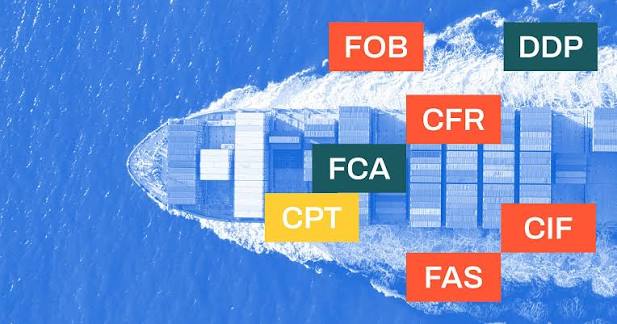
A list of available Incoterms is below … the most commonly used are EXW, FOB, CIF, and DDP
Incoterms® 2020 — Quick Reference
The 11 Incoterms® 2020 rules define which party is responsible for delivery, transportation costs, customs responsibilities, and risk. The named place should always be specified with the Incoterm.
| Incoterm | Full Name | Meaning / Responsibility |
| EXW | Ex Works | Seller makes the goods available at its premises. Buyer handles pickup, transport, export/import clearance, and most costs and risks from that point. |
| FCA | Free Carrier | Seller delivers the goods to the carrier or another party nominated by the buyer at an agreed place. Seller handles export clearance; risk transfers at delivery. |
| CPT | Carriage Paid To | Seller pays transportation to the named destination, but risk transfers to the buyer when the goods are handed to the first carrier. |
| CIP | Carriage and Insurance Paid To | Same basic structure as CPT, but seller also provides cargo insurance to the required level. |
| DAP | Delivered At Place | Seller bears costs and risk to bring goods to the named destination, ready for unloading. Buyer handles unloading and import clearance/duties. |
| DPU | Delivered at Place Unloaded | Seller bears costs and risk to the named destination and is responsible for unloading the goods. Buyer handles import clearance/duties. |
| DDP | Delivered Duty Paid | Seller bears essentially all costs and risks to the named destination, including export/import clearance and import duties/taxes. |
| FAS | Free Alongside Ship | Seller places the goods alongside the vessel at the named port. Buyer handles loading, ocean freight, insurance, and onward costs/risk. |
| FOB | Free On Board | Seller loads the goods on board the vessel at the named port. Risk transfers when the goods are on board. Buyer pays ocean freight and onward costs. |
| CFR | Cost and Freight | Seller pays ocean freight to the named destination port, but risk transfers to the buyer once goods are on board the vessel. |
| CIF | Cost, Insurance and Freight | Same as CFR, but seller also provides marine cargo insurance to the required level. |
A Costly Misunderstanding (“an example”)
A mid-size electronics company sourcing sub-assemblies from a supplier in Shenzhen agreed to “FOB” terms without much discussion; it sounded standard, and the supplier used it on every quote. Weeks later, the shipment arrived at the destination port with water damage from a rough sea crossing. The buyer assumed the supplier’s freight arrangement meant the supplier was still on the hook, but they weren’t. Under FOB, Free On Board, without listing Origin or Destination, the law treats the terms as Origin and the risk had transferred to the buyer the moment the goods cleared the ship’s rail in China. No coverage, no recourse, a five-figure loss on a line item nobody had scrutinized.
The term wasn’t wrong. The understanding of what it meant was.
What Incoterms Actually Are and Aren’t (“a brief overview”)
Incoterms, short for International Commercial Terms, are a set of standardized trade terms published and maintained by the International Chamber of Commerce (ICC). They define one thing precisely: at what point does responsibility for the goods, the shipping costs, and the risk of loss shift from the seller to the buyer.
What Incoterms are not:
• They are not payment terms. Incoterms have nothing to do with when or how you pay your supplier (that’s a separate negotiation — deposits, net terms, letters of credit, etc.).
• They are not a transfer of legal title. Ownership of the goods is a contract law question, and Incoterms don’t address it.
• They are not a substitute for insurance. Some terms require the seller to insure the goods, but most don’t. Assuming coverage exists because “it’s in their freight term” is one of the most common and costly mistakes buyers make.
Getting this distinction correct is the single biggest unlock to understanding Incoterms. Everything else builds upon it.
Risk vs. Cost vs. Responsibility (”the Core Concept”)
Every Incoterm answers these three separate questions, and they don’t always change hands at the same point in the journey. This is where most confusion happens, buyers assume “whoever pays for freight is liable for the cargo,” and that’s often false.
The Terms That Matter Most When Importing from Asia
Of the 11 Incoterms published by the ICC, most buyers sourcing from Asia regardless of where they’re importing to will only ever encounter four. Here’s what each one actually means for you, and not the textbook definition but a practical one.
EXW (Ex Works) The supplier makes the goods available at their factory door. That’s it. You (or your freight forwarder) are responsible for everything from that point forward, including export clearance, loading, ocean freight, import clearance, and inland delivery. It looks like the cheapest quote on paper because it strips out everything the supplier won’t be doing. In practice, it’s the highest-risk, highest-effort term for a buyer without strong logistics infrastructure or a freight partner who knows how to navigate Asian export/US import requirements.
FOB (Free On Board) The most commonly used, and most commonly misunderstood term in Asia sourcing. The supplier handles export clearance and delivery to the port, and risk transfers to you once the goods are loaded onto the vessel. This is a reasonable middle ground if you have a freight forwarder managing the ocean leg of the journey and you’ve confirmed who’s insuring the cargo in transit. The mistake buyers make is assuming FOB means “the supplier’s got this handled” well past the point where that’s actually true. That often comes from the misconception that FOB, refers to FOB Destination when instead FOB by itself means FOB Origin.
CIF (Cost, Insurance, and Freight) The supplier arranges and pays for ocean freight and insurance to your destination port, but risk still transfers to you once goods are loaded which is the same pivot point as FOB. The insurance requirement is the key difference, but it’s worth checking what coverage level is included; ICC minimum coverage is often thinner than buyers assume, and topping it up may be worth the small added cost.
DDP (Delivered Duty Paid) The supplier handles everything, including import customs clearance and duties, delivering goods to your door. It sounds like the easiest option, and sometimes it is but it also means you have zero visibility into and no control over how your goods clear customs in your own country. If a supplier is pushing DDP hard, it’s worth asking why: sometimes it’s genuine service, sometimes it’s a way to obscure landed cost or route around compliance the buyer would otherwise want line-of-sight into.
Common Mistakes That Buyers Make
• Treating the Incoterm as boilerplate. It’s negotiated language, not a formality, and suppliers often default to whichever term benefits them, not you.
• Assuming insurance exists when it doesn’t. Outside of CIF/CIP, cargo insurance is rarely automatic. Confirm it explicitly, every time.
• Mismatching Incoterms with payment terms. Paying a large deposit under EXW terms, for example, means you’ve taken on both financial exposure and logistics risk simultaneously, sometimes a combination worth avoiding.
• Not revisiting the term when the relationship matures. The right Incoterm for a first small-batch order with a new supplier may not be the right one as volume and trust increase.
How to Choose the Right Incoterm for Your Situation
Run through these four questions before your next PO goes out:
1. Do you have (or can you access) reliable freight forwarding on the ground in Asia? If not, terms that push logistics responsibility onto you, like EXW, carry more operational risk than the quote suggests.
2. How experienced is your supplier with export documentation? A supplier new to exporting can turn “supplier handles customs” into your problem, regardless of what the Incoterm says on paper.
3. What’s the value and fragility of the cargo? Higher-value or higher-risk shipments justify paying more attention to exactly when risk transfers, and making sure insurance is in place before that point.
4. Do you want visibility and control, or convenience? DDP buys convenience at the cost of visibility. FOB or CIF trade a bit of convenience for more control. Neither is universally right, it depends on how much you want to manage versus delegate.
Where This Fits in the Bigger Sourcing Picture
Incoterms are one clause in a much larger negotiation, and getting them wrong rarely shows up as a problem until the goods are already in transit and it’s too late to fix. The buyers who avoid costly surprises aren’t the ones who’ve memorized all 11 terms. They’re the ones who have someone on the ground who negotiates these terms as a matter of routine, catches the mismatches before they become disputes, and knows which suppliers use Incoterms fairly versus which ones use them as a lever.
That’s the kind of protection SureSource builds into every sourcing relationship we manage, from initial supplier vetting through the fine print of every shipment. If you’re not sure whether your current terms are protecting you or quietly exposing you, talk to SureSource before your next order ships.